
5,000 Applications Later: Why Job Seekers Say Hiring Is Broken in 2026 (And How Career Coaching Actually Fixes It)

If you’ve sent dozens, or even hundreds, of applications and barely heard back, you are not imagining the problem.
In 2026, job seekers are competing in a hiring system overloaded by applications, automation, unclear job postings, and inconsistent communication. A recent USA TODAY report highlighted the story of Candee Petersen, who said she remained without a full-time role after roughly 5,000 applications.
That number is hard to process. But the real issue is not that job seekers are lazy, unqualified, or failing to try hard enough.
The issue is that volume has replaced strategy.
When the answer to a difficult job search is simply “apply to more jobs,” you can spend months working harder without getting closer to an offer. That is where career coaching makes a practical difference: it helps you replace random activity with a focused system for positioning, targeting, networking, and interview conversion.
🚨 Why Hiring Feels Broken in 2026
Several forces are colliding at once:
More candidates are applying to the same roles.
Employers are receiving hundreds of applications within days.
Applicant tracking systems are filtering resumes before a human sees them.
AI-generated applications are making candidate materials look increasingly similar.
Some job postings are paused, internal, outdated, or never actively filled.
Candidates are often left without feedback, or any response at all.
According to the USA TODAY coverage, applicants per open role have doubled since spring 2022, while recruiters are processing significantly more applications per hire. Meanwhile, Fortune reported that employers and job seekers are caught in an “AI doom loop”: candidates use automation to apply faster, employers use automation to filter faster, and both sides lose meaningful human connection.
This creates a frustrating cycle:
You apply to a role.
You hear nothing.
You assume you need more applications.
You apply more broadly and with less customization.
Your materials become less relevant to each job.
You still hear nothing.
The cycle can make you question your skills, your degree, and your entire career direction. But silence is not proof that you lack value. Often, it is a sign that your job search strategy is not creating enough visibility or relevance.
🎯 Stop Mass-Applying and Start Targeting
The goal is not to apply to every job that contains one familiar keyword.
The goal is to identify the roles where your skills, interests, and potential make sense, and then present yourself clearly for those opportunities.
Start by defining:
One or two target job titles
Two or three industries or work environments
A list of 20–40 companies worth pursuing
The problems you can help those employers solve
For example, “I’m looking for any entry-level business job” is too broad. A sharper target might be:
“I’m targeting HR coordinator and recruiting coordinator roles in healthcare organizations where I can use my communication, scheduling, research, and people skills.”
That statement gives you direction. It also makes your resume, LinkedIn profile, networking messages, and interview answers easier to build.
For recent graduates, targeting does not mean you need years of experience. It means you need to connect your existing evidence to the employer’s needs.
That evidence might include:
A class project
An internship
Campus leadership
Volunteer work
Customer service
Freelance work
A portfolio project
Technical training
A measurable improvement you created in a part-time role
Career coaching helps you uncover those connections instead of dismissing your experience as “not relevant.”
🧩 Build a Positioning Statement That Makes Sense
Many early-career professionals struggle because their resumes describe responsibilities but do not communicate value.
Compare these two examples:
Weak: “Helped customers and answered questions.”
Stronger: “Resolved customer questions across phone and email while maintaining accurate records and escalating complex issues to the appropriate team.”
The second version gives the reader more to work with. It shows communication, organization, judgment, and process awareness, skills that can transfer into operations, HR, customer success, healthcare administration, and other fields.
Your resume should answer three questions quickly:
What can you do?
What evidence proves it?
Why does it matter for this specific role?
This does not mean stuffing your resume with keywords or exaggerating your accomplishments. It means translating your experience into language that both applicant tracking systems and human reviewers can understand.
A career expert can help you identify your transferable skills, choose the right keywords, and create a resume that supports your target rather than trying to appeal to everyone.
🔎 Make Your LinkedIn Profile Searchable and Credible
Your job search does not begin and end with an application.
Recruiters and hiring managers may search for candidates before reviewing an application. Your LinkedIn profile should reinforce the story your resume tells.
Focus on:
A headline that includes your target role and key strengths
An About section that explains what you are pursuing
Experience bullets that show outcomes and skills
Relevant projects, certifications, and coursework
A professional photo and complete profile
Thoughtful activity related to your target field
You do not need to become a full-time content creator. One useful post or a few meaningful comments each week can help you become more visible and demonstrate genuine interest.
For example, if you are pursuing IT support, comment on discussions about troubleshooting, cybersecurity awareness, or user experience. If you want to enter HR, engage with conversations about employee development, recruiting, or workplace culture.
The objective is not to perform online. It is to become easier to find and easier to understand.
🤝 Move Relationships Ahead of the Application Pile
Some opportunities are never widely advertised. Others are posted publicly but filled through an internal referral or an existing relationship.
That does not mean you need to know influential executives. Start with realistic connections:
Alumni from your school
Former classmates
Managers from internships or part-time jobs
Professionals in your target companies
Members of industry associations
People you meet through local or virtual events
Send a short message that focuses on learning, not asking for a job:
“Hi Jordan, I’m exploring HR coordinator roles in healthcare and noticed your experience at Memorial Health. I’m especially interested in how early-career professionals can build strong recruiting skills. Would you be open to a brief conversation about your path?”
That message is specific, respectful, and easy to answer.
A structured job search strategy may include a weekly networking goal, such as two new conversations and one follow-up. Over time, those conversations can lead to advice, referrals, project opportunities, and better insight into how companies actually hire.
🎤 Convert More Interviews Into Offers
Getting an interview is progress: but it is not the finish line.
Many candidates lose momentum because they prepare by memorizing generic answers. Strong interview preparation is more strategic. You should be ready to explain:
Why you want this role
Why you want this company
What you have accomplished
How you handle challenges
What you learned from mistakes
How your background connects to the job
What you can contribute in your first months
Use a simple story structure:
Situation: What was happening?
Task: What responsibility did you have?
Action: What did you do?
Result: What changed because of your actions?
You can use this structure for internship experiences, school projects, volunteer work, and part-time jobs: not just traditional professional roles.
Career coaching also gives you a place to practice out loud, receive direct feedback, and build confidence before the real conversation. Confidence is not pretending to know everything. It is knowing how to communicate what you do know.
🛠️ How Career Coaching Fixes the Broken Search
Effective career coaching does not promise to bypass every difficult part of the job market. It gives you a better way to respond to it.
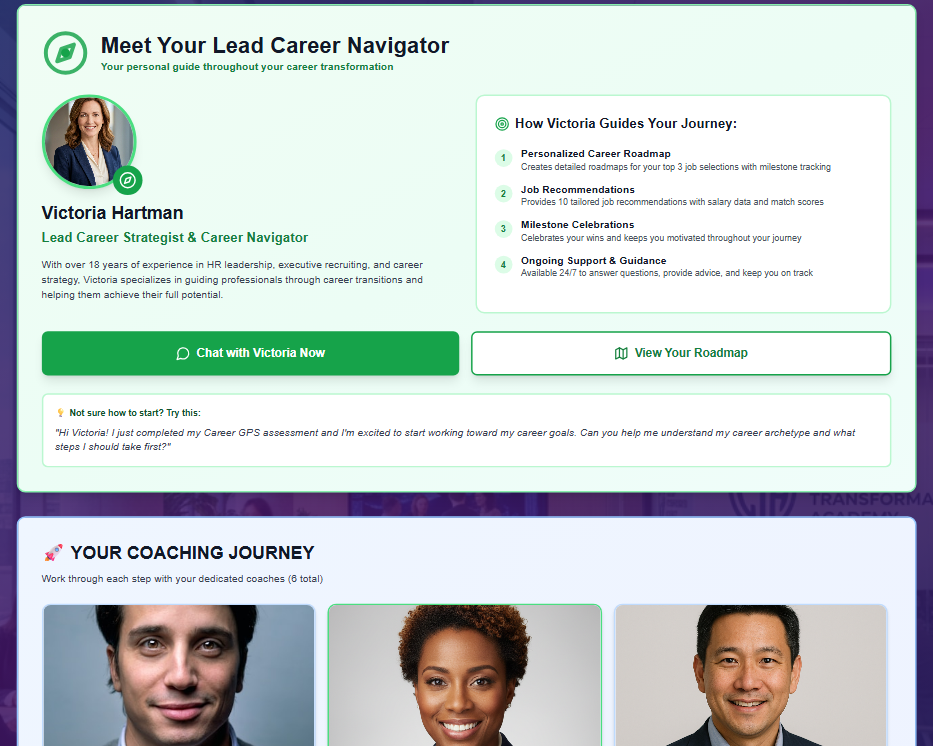
At Career Transformation Academy, the process follows four connected steps:
That structure matters because a weak job search rarely has only one problem. You may need a clearer target and a stronger resume. You may need better networking habits and more focused interview preparation. A connected system helps you improve the entire journey instead of repeatedly changing one document and hoping for a different result.
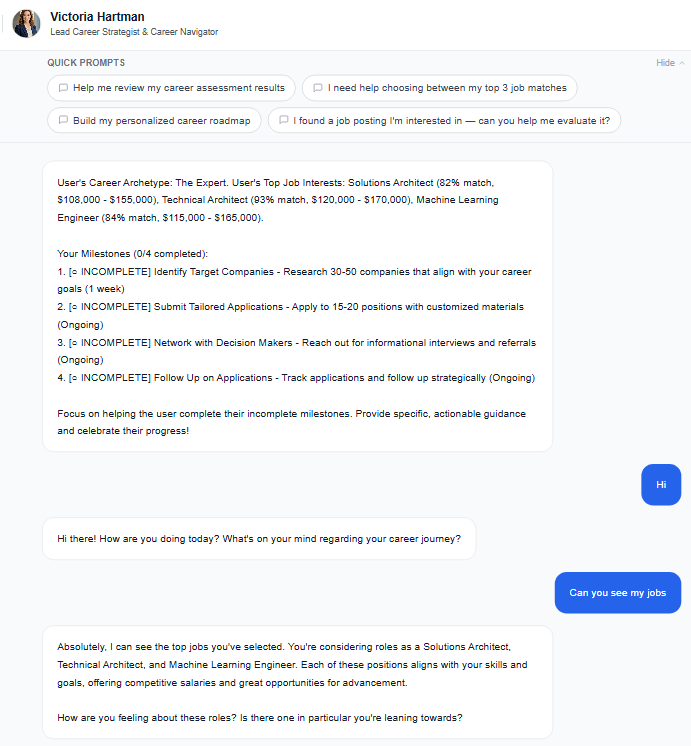
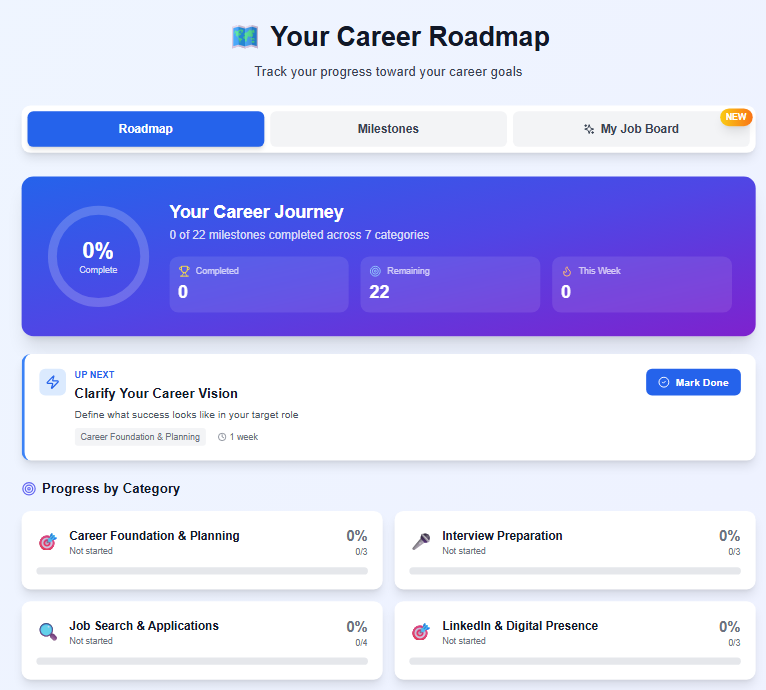
CareerGPS provides 24/7 AI-powered support for resume feedback, career direction, interview preparation, job matching, and milestone tracking. You can start the seven-day free trial and use the coaching tools when you need them: before an application deadline, after a difficult interview, or while deciding which opportunity deserves your time.
✅ Your Next Three Moves
If your job search feels like an endless application treadmill, do not respond by applying to even more jobs today.
Instead:
1. Pause and audit
Review your last 20 applications. How many matched your actual target role? How many used a tailored resume? How many led to a conversation?
Look for patterns: not reasons to blame yourself.
2. Choose a narrower target
Select one or two job titles and create a list of companies where those roles exist. Your focus will make every future action more effective.
3. Build a weekly system
Try this rhythm:
Submit 5–10 targeted applications
Reach out to two professionals
Improve one section of your resume or LinkedIn profile
Practice two interview stories
Review your results at the end of the week
Track your activity in a simple spreadsheet or career roadmap. The goal is not frantic productivity. The goal is learning what creates movement.
🌟 Hiring May Be Broken. Your Career Is Not.
The 2026 job market is demanding more clarity, relevance, and persistence than ever. But sending 5,000 applications is not the only form of persistence: and it is rarely the most effective one.
You do not need to become a different person to get hired. You need a strategy that helps employers recognize the value you already bring.
Target better. Position yourself clearly. Build real relationships. Practice your story. Track what works.
And if you are ready for support, connect with Career Transformation Academy and take your next step with a career expert and a structured coaching system behind you.
Comments