
Ghosted After the Interview? The Follow-Up Framework That Revives Dead Applications

You nailed the interview.
You answered clearly. You connected with the hiring manager. You left thinking, “This could actually work.”
Then, silence. 😰
No update. No rejection. No next steps.
Just a growing temptation to refresh your inbox every five minutes and wonder:
“Did I say something wrong?” “Was another candidate better?” “Should I follow up again, or will I look desperate?”
Take a breath.
Being ignored after an interview feels personal, but it often isn’t. Hiring processes stall for reasons that have little to do with your performance.
This guide gives you a clear, professional follow-up framework, and shows how interview preparation coaching can help you manage both the interview and everything that happens afterward.
✅ Quick start: Save this timeline now, then begin a free career assessment at CTA GPS.
FIRST, UNDERSTAND WHAT SILENCE USUALLY MEANS
Post-interview ghosting can happen even when the conversation went well.
According to Indeed’s guidance on being ghosted after an interview, common causes include internal candidates, a position being eliminated, a slower-than-expected hiring process, or a large number of applicants.
Robert Half also points to several possibilities:
Budget cuts or delayed approvals
Internal changes within the organization
Competing candidates still being interviewed
A hiring manager becoming overwhelmed
The role being paused or restructured
The company choosing another candidate but failing to communicate it
So, one week of silence is not automatically a rejection.
It may mean the recruiter is waiting for finance approval. The hiring manager may be comparing finalists. The company may be dealing with a reorganization.
None of those situations tell you that you performed badly.
That said, uncertainty is not a reason to wait passively. A calm, well-timed follow-up keeps you visible without becoming intrusive.
✅ Free action: Write down the date of your interview, the promised decision date, and every contact you have. Start your follow-up plan in two minutes.
THE FOUR-STEP FOLLOW-UP FRAMEWORK
Use this framework to replace guessing with a professional plan.
Timing | Goal | What to send |
Within 24 hours | Reinforce the connection | Personalized thank-you note |
Day 5–7 | Request a status update | Brief check-in |
Around two weeks | Reconfirm interest | Value-focused nudge |
Day 17–21 | Close the loop gracefully | Final touch |
If the interviewer gave you a specific timeline, use that as your anchor. When the promised date passes, wait one or two business days before checking in.
Do not send all four messages if the company responds earlier. The framework is a safety net, not a script you must complete.
✅ Quick start: Put these four dates on your calendar so your follow-up strategy, not your anxiety, sets the pace.
STEP ONE: SEND THE 24-HOUR THANK-YOU NOTE
Send your thank-you message within 24 hours whenever possible.
This is not just a courtesy. It gives you one more opportunity to connect your experience to the company’s needs.
Avoid sending a generic message such as, “Thanks for your time. I look forward to hearing from you.”
Instead:
Mention something specific from the conversation.
Reinforce one relevant strength.
Express continued interest.
Keep it short.
24-HOUR THANK-YOU SCRIPT
Subject: Thank you, [Job Title] interview Hi [Name], Thank you for taking the time to speak with me about the [Job Title] position today. I enjoyed learning more about [specific project, challenge, or team priority]. Our conversation reinforced my interest in the role, especially because my experience with [relevant skill or accomplishment] could help support [specific business goal]. Please let me know if I can provide any additional information. I appreciate your time and look forward to hearing about the next steps. Best, [Your Name]
If you interviewed with multiple people, personalize each note. Do not copy and paste the exact same email to everyone.
✅ Free action: Draft your thank-you note now, even if your next interview has not happened yet.
STEP TWO: SEND THE 5–7 DAY CHECK-IN
If you have heard nothing after five to seven business days, send a polite check-in.
If the employer promised an update by Friday, follow up one or two business days after that deadline.
Your message should be confident, not apologetic.
You are not asking, “Did I get the job?”
You are asking whether the process is still active and whether the team needs anything from you.
5–7 DAY CHECK-IN SCRIPT
Subject: Following up on [Job Title] Hi [Name], I wanted to follow up on my interview for the [Job Title] position. I remain very interested in the opportunity and enjoyed learning more about [company priority or team]. Do you have an updated timeline for next steps? I would be happy to provide any additional information that would be helpful. Thank you again for your time. Best, [Your Name]
This message works because it does three things:
Reminds the hiring team who you are
Reaffirms your interest
Makes it easy for them to reply with a timeline
Do not send an emotional message. Avoid lines like:
“I assume you have moved on with another candidate.”
“I have been waiting for a response.”
“I deserve the courtesy of an answer.”
“Why has nobody contacted me?”
You may feel those things. Send none of them. 😤
✅ Quick start: Copy the script, personalize three details, and schedule it for the next appropriate business morning.
STEP THREE: SEND THE TWO-WEEK NUDGE
Still no response around two weeks after the interview?
Send a shorter, value-focused nudge.
This is your opportunity to remind the employer why you are a strong fit without repeating your entire application.
Mention a relevant accomplishment, insight, or resource. For example, you might reference a project you discussed or briefly explain how you would approach one of the role’s priorities.
TWO-WEEK NUDGE SCRIPT
Subject: Still interested in [Job Title] Hi [Name], I wanted to check in regarding the [Job Title] position. I remain very interested in joining [Company] and contributing to [specific team goal]. Since we spoke, I was thinking about our conversation around [challenge discussed]. In my previous role, I [brief accomplishment or relevant result], and I would be excited to bring that experience to your team. If the role is still active, I would welcome the opportunity to discuss next steps. Do you have an updated timeline? Best, [Your Name]
Keep this message focused. Do not attach new materials unless they add genuine value.
This is also the point where you should continue applying elsewhere. A promising interview is not an offer. Protect your momentum.
✅ Free action: Send this message only after checking that your example is relevant, specific, and easy to understand.
STEP FOUR: SEND THE GRACEFUL FINAL TOUCH
If you have sent a thank-you note and two follow-ups over roughly two to three weeks with no response, send one final touch.
The purpose is not to pressure the company.
It is to close the loop professionally, preserve the relationship, and free yourself emotionally.
GRACEFUL FINAL TOUCH SCRIPT
Subject: Closing the loop, [Job Title] Hi [Name], I wanted to send one final note regarding the [Job Title] opportunity. I understand priorities and timelines can change, and I appreciate the time you and the team invested in speaking with me. I remain interested if the position is still active, but I will continue pursuing other opportunities. Please feel free to reach out if the role moves forward or if another position becomes available that may be a fit. Wishing you and the team all the best, [Your Name]
Then stop following up.
No angry LinkedIn message. No repeated calls. No public complaint.
A graceful exit protects your reputation and your peace of mind.
✅ Quick start: Send the final touch, then redirect your energy to three new opportunities today.
HOW INTERVIEW PREPARATION COACHING HELPS AFTER THE INTERVIEW
Most people think interview preparation coaching ends when the video call ends.
It should not.
The strongest support continues through:
Reviewing what went well and what could improve
Identifying unanswered questions
Writing a strategic thank-you note
Choosing the right follow-up timing
Preparing for a second or final interview
Practicing salary and offer conversations
Managing confidence after a disappointing silence
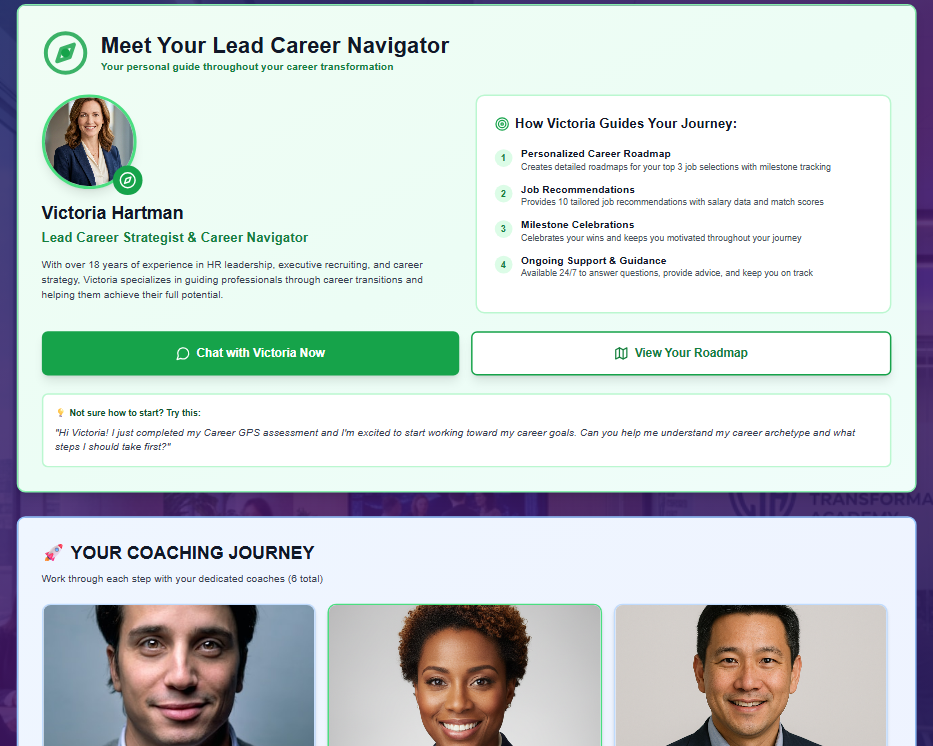
CTA GPS gives you access to specialized AI career coaches available 24/7. David Chen, the platform’s Interview Preparation Coach, can help you run mock interviews, sharpen your answers, review your performance, and build a post-interview communication plan.
You can share the job description, your interview notes, or the exact message you want to send. Instead of generic advice, you receive practical guidance tied to your role and goals.
And because CTA GPS includes specialized coaches for career strategy, resumes, LinkedIn, salary negotiation, and more, you do not have to solve every career problem with one generic tool.
✅ Free action: Start the 7-day CTA GPS trial and ask for a mock interview plus a follow-up plan.
YOUR NEXT MOVE IS CLARITY, not MORE GUESSING
Getting ghosted is frustrating. It can make you question your preparation, your qualifications, and your value.
But silence is not a verdict.
Use the framework:
Thank them within 24 hours.
Check in after five to seven business days.
Nudge them around the two-week mark.
Close the loop gracefully after two to three weeks.
Then keep moving.
The right employer will value your skills, your preparation, and your professionalism. With the right interview preparation coaching, you can turn every interview into useful progress, even when one company fails to communicate.
Start your free trial at ctagps.ai. Practice smarter. Follow up with confidence. Transform your next opportunity into a career move.
Comments